
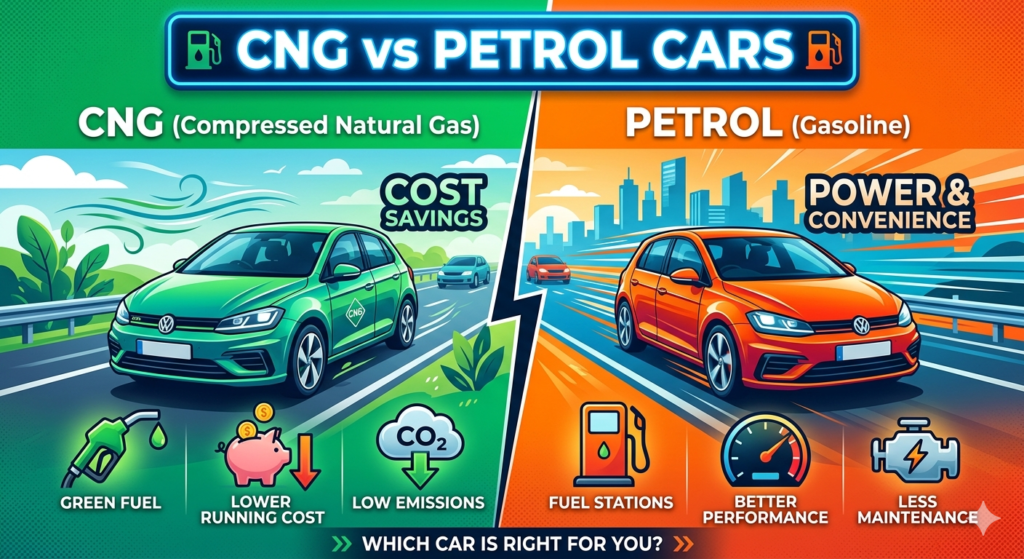
Confused between CNG Vs petrol cars? Discover the complete comparison of mileage, running cost, performance, maintenance, and practicality to choose the best car for your needs in India.
Buying a car today is not just about looks, features, or brand—it’s about long-term cost, usability, and practicality. One of the biggest dilemmas Indian buyers face is choosing between a CNG car and a petrol car. With rising fuel prices and increasing daily commute distances, this decision can significantly impact your monthly budget and driving experience.
In this detailed blog, we will break down the real-world differences between CNG and petrol cars in a simple, practical way so that you can make a confident purchase decision.
CNG vs Petrol Car : Understanding the Basics
A petrol car runs on petrol fuel and has been the most common choice in India for decades. These cars are known for their smooth performance, better pickup, and convenience.
Running Cost: The Biggest Deciding Factor
If your main concern is saving money, CNG clearly has an advantage. The cost of CNG fuel is significantly lower than petrol, and it also offers better mileage. This combination leads to a much lower cost per kilometer.
In practical terms, a CNG car can cost almost 40–50% less per km compared to petrol. This makes a huge difference if you drive daily or cover long distances regularly.
Petrol cars, however, come with higher fuel expenses. Even though they may have a slightly better range per tank, the cost of fuel makes them expensive to run over time.
Mileage Comparison
Mileage is another key factor where CNG cars shine. A typical petrol car gives around 18–22 km/l, while a CNG car can deliver around 25–30 km/kg This higher efficiency, combined with cheaper fuel, is why CNG vehicles are considered the most economical option for daily commuting.
CNG vs Petrol Car : Performance and Driving Experience
This is where petrol cars clearly win.
Petrol engines provide better power, smoother acceleration, and an overall more enjoyable driving experience. If you enjoy driving, frequently overtake on highways, or travel with full load, petrol cars feel more responsive and refined.
CNG cars, in comparison, have slightly lower power output. You may feel a lag during acceleration, especially on highways or when driving uphill. This is because CNG burns differently and produces less energy than petrol.
However, modern CNG cars come with dual-fuel technology, allowing you to switch to petrol when you need extra power.
Boot Space and Practicality
One of the biggest drawbacks of CNG cars is reduced boot space. The CNG cylinder is usually installed in the trunk, leaving less room for luggage. This can be inconvenient for families, long trips, or airport travel.
Petrol cars, on the other hand, offer full boot space and better practicality for all kinds of usage.
Long-Term Ownership Perspective
Over a long period, the savings from CNG can be substantial if your monthly running is high. Many users recover the extra cost of a CNG car within 1–2 years through fuel savings alone.
However, if your usage is low (for example, occasional driving or less than 800–1000 km per month), the savings from CNG may not justify the higher initial cost and compromises.
CNG vs Petrol Car : Final Verdict : Which One Should You Buy?
There is no one-size-fits-all answer—it completely depends on your usage and priorities.
If your goal is maximum savings, daily commuting, and low running cost, then a CNG car is the smarter choice.
If you prefer better performance, convenience, and occasional use, then a petrol car is the better option.
CNG vs Petrol Car : Conclusion
The CNG vs petrol debate is not about which is better overall—it’s about which is better for you. CNG offers unmatched savings and efficiency, while petrol delivers superior driving comfort and convenience.
Before making your final decision, think about your monthly usage, nearby fuel availability, and long-term plans. A well-informed choice today can save you thousands of rupees—and a lot of regret—tomorrow.
Sources :