
When most people think of the Mahabharata, they remember the great Kurukshetra War, the wisdom of the Bhagavad Gita, and the victory of the Pandavas over the Kauravas. But the Mahabharata doesn’t actually end with the war.
In fact, the final chapters of the epic contain one of its most powerful messages. Sage Ved Vyasa chose to end the world’s greatest epic not with a celebration of victory, but with a lesson about life, duty, and what truly matters in the end.
What Happened After the War?
After the Kurukshetra War, the Pandavas ruled Hastinapura for many years. Their kingdom was prosperous, and peace had finally returned to the land.
But as time passed, King Yudhishthira began to understand something that every person eventually faces: no amount of power, wealth, or success lasts forever.
When Lord Krishna left the world and the Yadava dynasty came to an end, the Pandavas decided that their time as rulers was over. They handed over the kingdom and set out on their final journey, known as the Mahaprasthana, or the Great Journey.
The Final Journey to the Himalayas
Leaving behind their royal lives, the Pandavas and Draupadi began walking toward the Himalayas. As they traveled, one by one, their companions fell. Draupadi was the first to fall. Then came Sahadeva, Nakula, Arjuna, and finally Bhima. Yudhishthira alone continued walking.
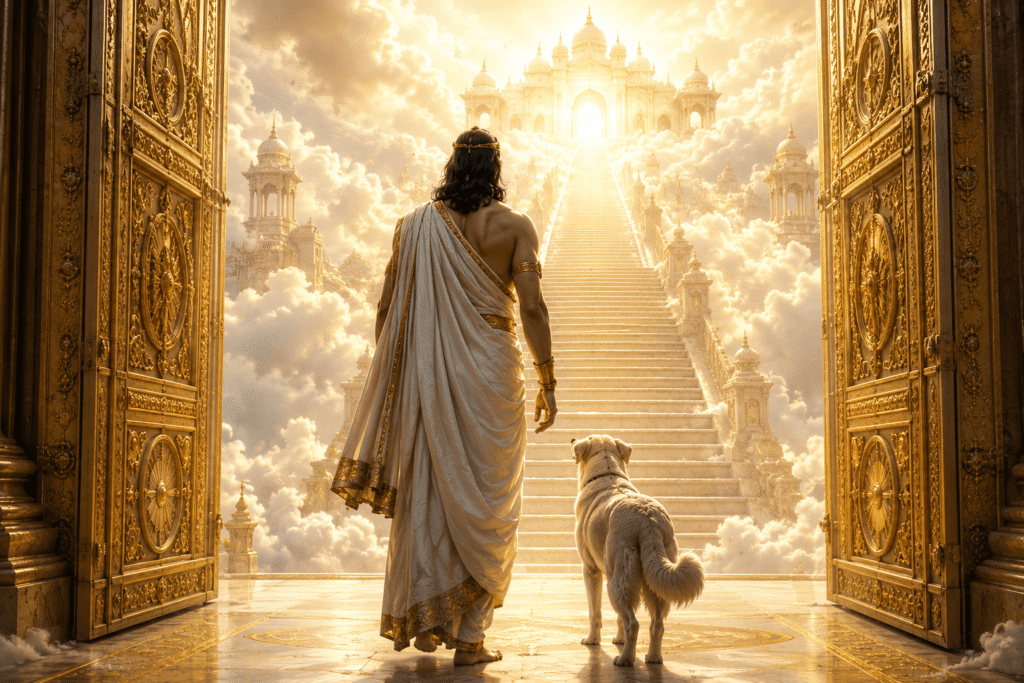
The only companion left beside him was a faithful dog that had followed him throughout the journey. It’s a simple detail, but it becomes one of the most meaningful moments in the entire Mahabharata.
Yudhishthira’s Last Test
As Yudhishthira reached the end of his journey, Lord Indra arrived with a celestial chariot and invited him to enter heaven. For most people, the choice would have been easy. But there was one condition. The dog could not come. Yudhishthira refused. He could not abandon a loyal companion who had stayed with him through every hardship. Even for heaven, he was unwilling to betray his principles. At that moment, the dog revealed his true identity. It was Dharma, the god of righteousness and Yudhishthira’s divine father, who had been testing him all along.
Yudhishthira had passed the final test , not through strength, intelligence, or victory in battle, but through compassion, loyalty, and unwavering commitment to dharma.
The Real Message of the Mahabharata
Many people see the Kurukshetra War as the climax of the Mahabharata. But the ending tells us something even more important. The epic reminds us that power is temporary. Kingdoms rise and fall. Wealth comes and goes. Even the greatest warriors eventually leave the world behind.
What remains is our character. How we treat others. The choices we make when nobody is watching. And whether we stay true to our principles when it would be easier not to.
“The Mahabharata ends not with the triumph of power, but with the triumph of righteousness.”
Lessons We Can Still Learn Today
Even thousands of years later, the ending of the Mahabharata feels surprisingly relevant.
- Success and power are temporary.
- Wealth cannot be taken with us.
- Loyalty matters more than personal gain.
- True character is revealed during difficult choices.
- The greatest battle is often the one within ourselves.
In a world that constantly pushes us to chase status, money, and recognition, the Mahabharata reminds us to focus on something deeper.
Conclusion
The final image of the Mahabharata is not a king sitting on a throne or a warrior celebrating victory. It is a man walking toward heaven, refusing to abandon a loyal companion.That is why the ending of the Mahabharata remains so memorable. It teaches us that life’s greatest achievements are not measured by the battles we win, but by the values we uphold. Kingdoms may disappear. Victories may become history But Dharma remains eternal.